

By: Haley Fredricking
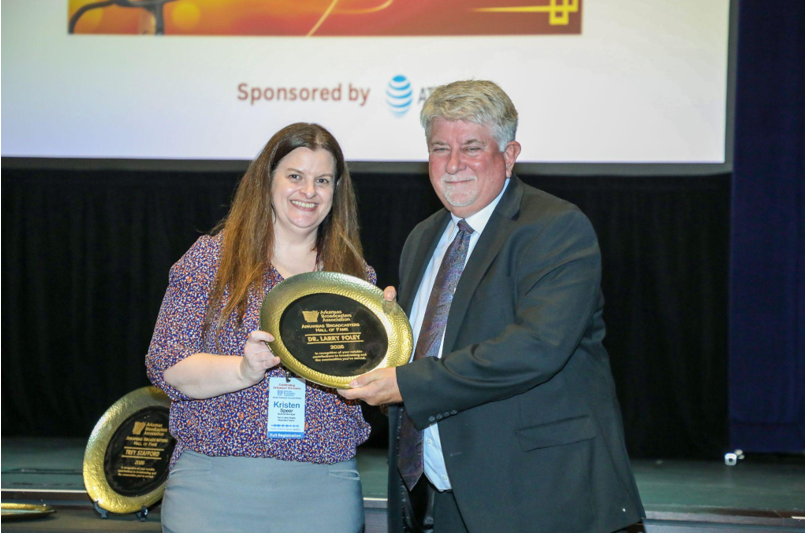
FAYETTEVILLE, Ark. (UATV) — Former University of Arkansas professor Dr. Larry Foley was inducted into the Arkansas Broadcasters Hall of Fame.
Foley was one of five broadcasters inducted this year, honoring his impact through decades of work in Arkansas broadcasting and journalism.
Throughout his career, Foley has made an impact across Arkansas as both a journalist and educator.
Neal Gladner, Executive Director of the Arkansas Broadcasters Association, said Foley’s passion for storytelling extends into the classroom.
“He’s got a great passion for storytelling, followed by a great passion for how to teach young people how to be great storytellers.”
Foley started his career at KATV in Little Rock, where he worked as a reporter, editor, anchor, and sports producer.
He later worked at Arkansas PBS as a senior producer, producing documentaries focused on Arkansas history and culture.
Foley spent 33 years at the University of Arkansas, where he became chair and director of what is now the School of Journalism and Strategic Media.
At the University of Arkansas, he made an impact by teaching students and founding the campus television station, UATV.
By founding UATV, he helped create an opportunity for students to gain hands-on experience reporting, producing, and delivering news while still in college.
While teaching the next generation of journalists, Foley continued his own work by telling stories through documentary filmmaking, with much of his work focused on Arkansas history, people, and culture.
After he retired from the university this past year, the UATV studio was named the Larry Foley UATV Studio in recognition of his contributions to the journalism program and the television station he founded.
Only five people are selected for induction into the Arkansas Broadcasters Hall of Fame each year, making Foley part of a select group recognized for their contributions.
Dr. Blackstone, a journalism professor at the University of Arkansas, said Foley’s career in broadcasting and his impact on future journalists made him deserving of the nomination.
“If anyone seemed like they deserved the recognition, it just seemed like he was the guy.”