

By: Josh Droll
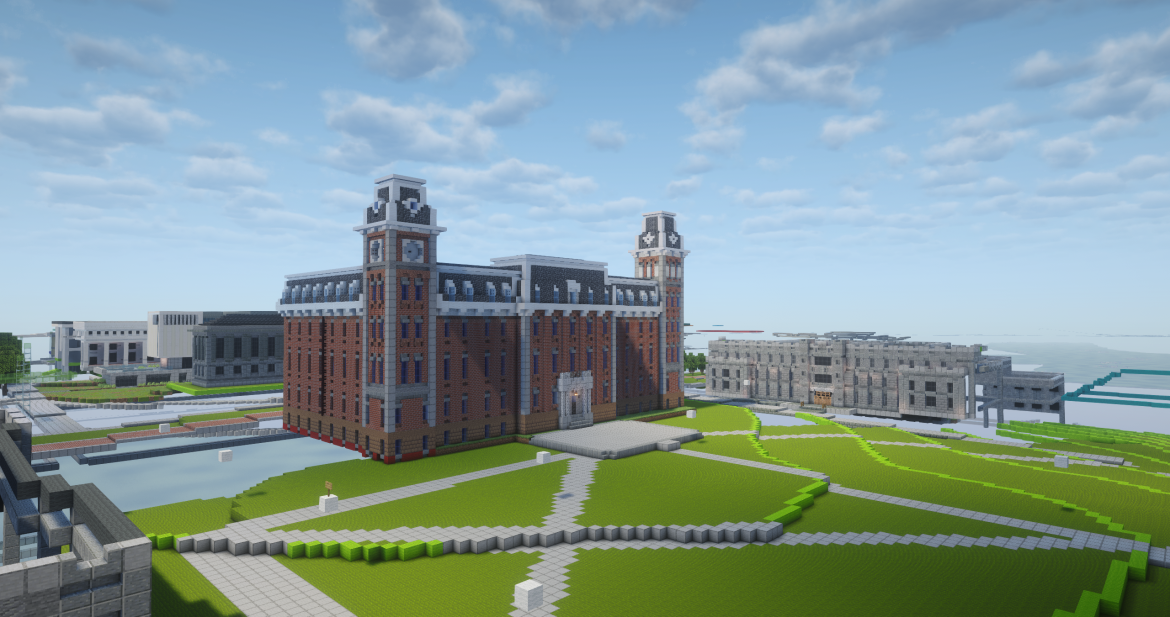
FAYETTEVILLE, Ark. — TJ Williams takes his knowledge and appreciation for Northwest Arkansas and converts it into a one-to-one model in Minecraft, a sandbox video game. What first appears to be a passion project integrates some architectural key skill sets that students face sooner or later as students of the Fay Jones School.
Williams started a social media page for this large-scale project, spanning approximately 50 real-world miles, called “nwa_in_mincraft” on Instagram in February of 2025. Williams said he had a plan and scheduled videos to give the page a boost from the jump, but it sat modestly at around 10,000 to 20,000 views per video. However, Williams did not stop posting, and when his time-lapse of building Cross Church in Rogers exploded to over 214,000 views, he said he received an outpouring of support and excitement.
“The reaction was very positive from everyone,” Williams said. “There were a few people that were like, ‘This part isn’t accurate in this part,’ like… It’s like, whatever. It’s fine. It’s not going to be perfect. But yeah, it was very overwhelmingly positive.”
Williams has already constructed numerous structures around the area, including much of the University of Arkansas’s campus, the Walmart Amp in Rogers, and Crystal Bridges in Bentonville. The key to creating the to-size models requires a couple of steps for Williams.
The first is to figure out the height of the avatar in the game, which Williams said the creator confirmed is approximately five feet 10 inches. Additionally, each block in the game is equal to one meter in any direction. Knowing this, Williams begins to cross-reference different images of various landmarks around the region, using images online, Google Earth Pro, and even performing site visits in-person to measure each new addition. From there, Williams begins to convert units from the imperial system to the game’s metric system.
“If I take the elevation from Google Earth in feet,” Williams said, “I then—I have to convert that into meters. So it’s—if I have an elevation of 100 feet, it’s 100 times .3048.”
He began to construct his world around places he had already been, and one day, his class did a site visit of a landmark he had already surveyed for his Minecraft project.
“Not too long ago, we did a site visit off of Dickson,” Williams said. “And it was funny because it’s like I could just do this myself in the project, so I’m just going to do that real quick. And I pretty much knew most of the site already, like, ‘Yeah, this is on an upslope, guys,’ or like, ‘This part right here dips down a little bit.’ Like that kind of thing. Like I knew about the site already.”
The implications and benefits of pursuing a virtual project—especially one with the unique challenges that Minecraft presents with exclusively blocks to build with—translate outside of the classroom, too.
Professor Phillip Zawarus is an instructor at the Fay Jones School of Architecture. This past summer, he acted as a mentor for Williams as he continued a separate summer project. During that summer is where Zawarus said he learned about TJ’s virtual model. He said the platform offers something new to a field that is constantly learning and evolving.
“We’re stuck with gravity that keeps us from seeing the way the world looks like from all sorts of different vantage points for us,” Zawarus said, “and things like Minecraft, you can really kind of start to disassemble things, you can reassemble them, you can have all sorts of different vantage points. So I think it brings a really new perspective.”
While the project is far from complete, filling out all of Northwest Arkansas is not the end for Williams. He said he wants to incorporate sounds and other custom mechanics in the game to make it more true to the reality he and others live every day. That would include cars that are actually drivable and lighting elements that mimic the Infinity Room at Crystal Bridges Museum of American Art.