

By: Aidan Loney
The University of Arkansas has officially dedicated the nation’s only openly accessible silicon-carbide semiconductor fabrication facility, marking a major milestone for U.S. innovation.
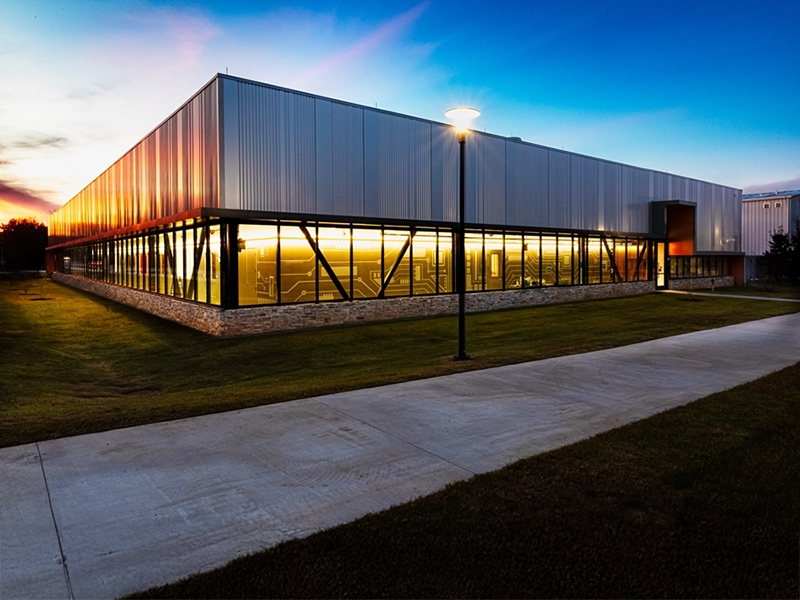
The Multi-User Silicon Carbide Facility (MUSiC) is the first-of-its-kind silicon-carbide fabrication facility in the U.S. that allows researchers to prototype, test proof-of-principle devices, and design new systems using silicon-carbide.
MUSiC is designed as a hands-on training ground for U of A students and other researchers. It creates an opportunity for students and visiting researchers to test silicon-carbide devices, build a pipeline for careers in power electronics, energy systems, and semiconductors.
U.S. Rep. Steve Womack, Arkansas Attorney General Tim Griffin, Kim Needy, dean of the College of Engineering, and founding director of the UA Power Group, Alan Mantooth, gathered in Fayetteville to celebrate the grand opening of the Multi-User Silicon Carbide Facility.
MUSiC was funded partially by the National Science Foundation’s Mid-Scale Research Infrastructure Program. It operates on a multi-project wafer model that supports shared prototyping across sectors. The facility sits in a 22,000-square-foot building with an eight-bay cleanroom, which is expandable to 10 bays in a planned Phase 2.
U of A’s Power Group, which integrates research from materials to systems, has more than $31 million in annual research spending, $150 million in core facilities, and 24 faculty across five departments, which makes it one of the largest academic power electronics teams in the nation.
MUSiC aims to help train the next generation of semiconductor and AI workers. The facility is designed to support both new and transitioning employees entering a rapidly growing industry, providing hands-on experience in semiconductor fabrication, materials engineering and systems integration.
The MUSiC facility, along with the High-Density Electronics Center and the National Center for Reliable Electric Power Transmission, forms one of the nation’s largest academic clusters for power and energy research. Together, the three centers support work in materials science, advanced packaging, circuit design, and power electronics.