

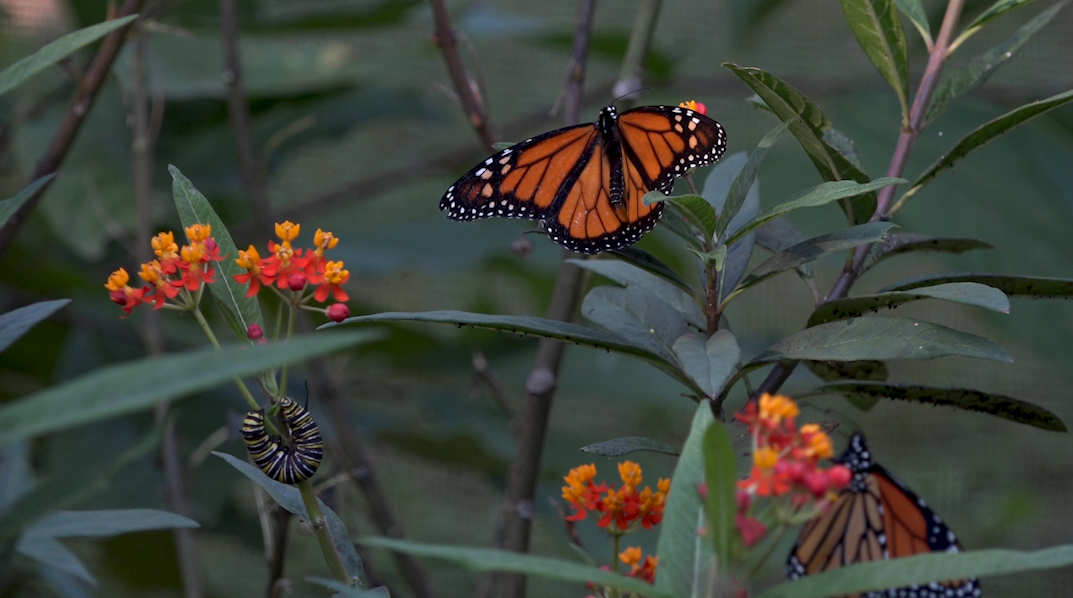
FAYETTEVILLE, Ark. – The city of Fayetteville handed out milkweed seeds to residents during its annual Celebration of Trees on October 11th.
The eastern monarch population (that migrates through Arkansas) has declined over 80% since the 1990s due to habitat loss. Monarchs are one of the biggest pollinators and an important food source for some birds and parasites. Northwest Arkansas is one of the last stopping points for monarchs on their migration to Mexico.
“Giving away milkweed seeds to the residents is a great way for us to help increase populations of the monarch butterfly, which is so important for pollination,” said John Scott, City of Fayetteville urban forester. “And, you know, we don’t have good pollinators, we don’t have food.”
Milkweed plants are essential to monarchs for several reasons. Milkweed is their only food source and the only plant that female monarchs will lay their eggs on.
The landscape of northwest Arkansas is a mix of agricultural and urban lands. Some of these agricultural lands are increasingly turning into a more urban environment.
“Even though milkweed can be seen as a weed in a hay meadow, it would still exist along fence rows and ditches and edges that just don’t get a chance to grow once it becomes urbanized, and you start mowing everything,” Austin Jones, an entomology professor at the University of Arkansas said. “You don’t have to protect a thousand acres to keep monarchs around. You have to have a few milkweeds here and there to be able to make their migrational path.”
A study done by the World Wildlife Fund-Telmex Telcel Foundation Alliance and the National Commission of Protected Natural Areas in Mexico found that monarchs occupied 1.79 hectares in December 2024. This is a 99% increase from 0.9 hectares in December 2023. Despite the increase, the monarch population is still 1.02 hectares below average.
Due to the population decline, in December 2024 U.S. Fish and Wildlife Service proposed a rule to list the monarch as a threatened species under the Endangered Species Act. The proposed rule can be found below. A final ruling will be issued in December 2025.