

By: Joshua Droll
FAYETTEVILLE, Ark. (UATV) — UA Power Group states on its website that engineers “train, educate, empower, and inspire a diverse population of engineers and leaders to address global energy challenges by fostering interdisciplinary collaboration, cutting-edge research, and experiential learning” within the confines of its research.
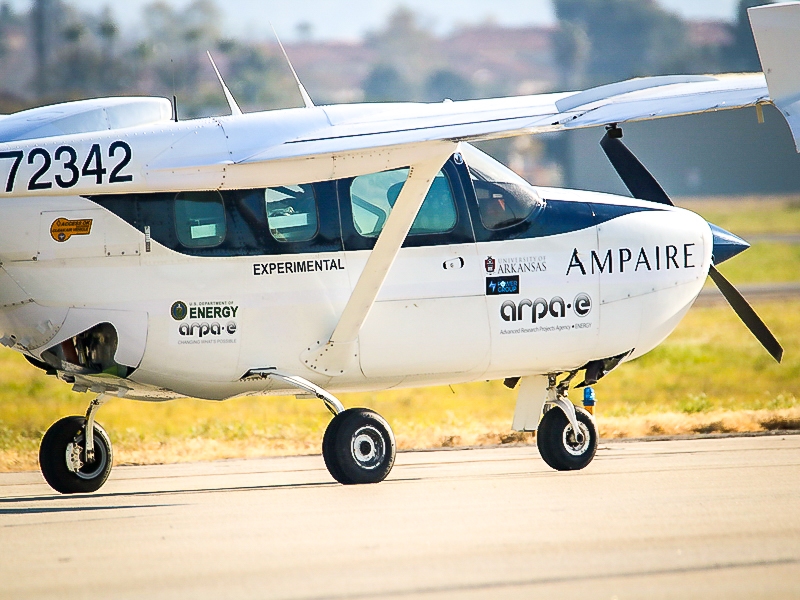
That research took to California skies back in 2023 in a test flight with a Cessna 337 hybrid plane. Traditionally, the plane is equipped with two motors: a diesel motor in the nose and an electric motor in the tail. However, UA Power’s engine is both in one: a slimmed-down version of a silicon carbide-based engine.
With these successful test flights, Alan Mantooth, a distinguished professor of electrical engineering and computer science, said the university has leaped into new territory.
“We were the first university to do this for a hybrid electric aircraft,” Mantooth said. “That’s a feather in our cap.”
How does this silicon carbide motor compare to a traditional motor in planes today? All motors have one thing in common: a transistor, which allows the energy to start and stop generating energy. The key difference between a traditional motor and UA Power Group’s silicon carbide motor is that the transistor can switch on and off at one thousand times the speed of a regular silicon motor. This means less lost energy, less generated heat, and a more efficient motor.
The reduced size, too, makes it easier for the planes to take off. This challenge was taken on by students within the UA Power Group’s program, and Mantooth said he is grateful for the opportunity to test projects like the silicon-carbide motor outside of the classroom.
“The students got a second-to-none experience,” Mantooth said. “They got to do some hands-on engineering in addition to their scientific work, and they went on and got great jobs.”